

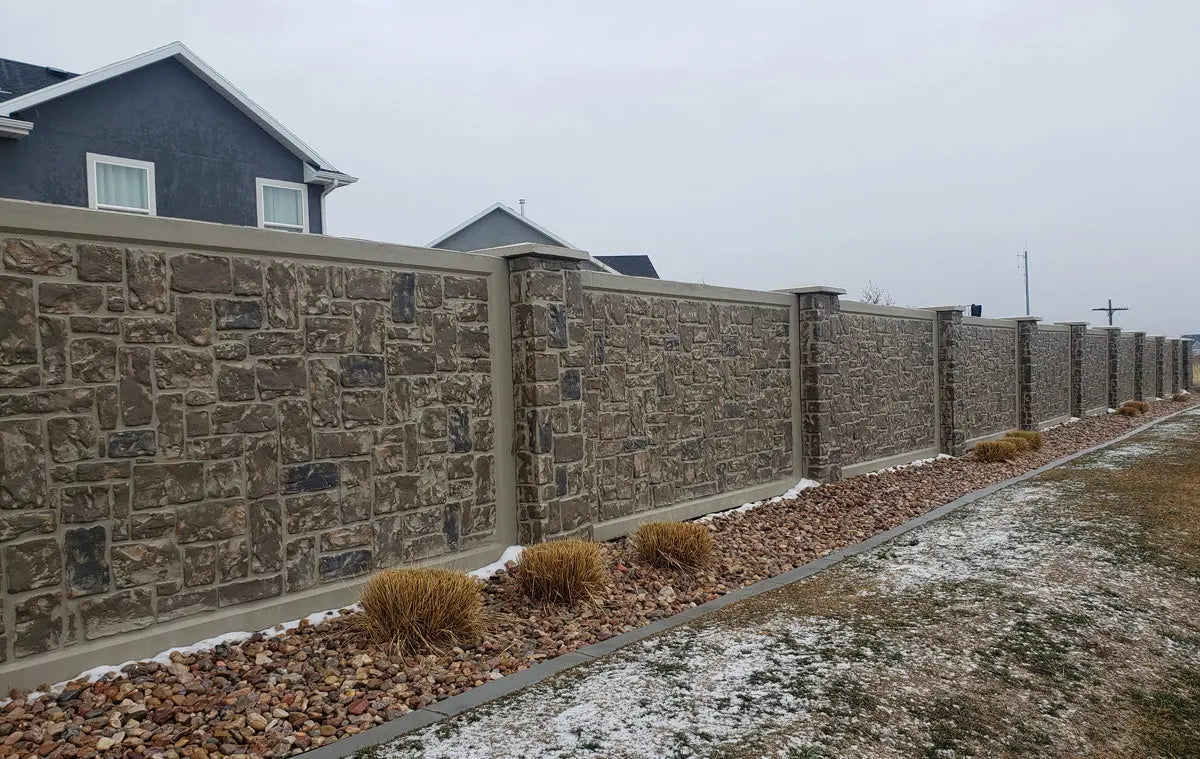


Concrete Fence and Column Liner Molds
NO FREE SHIPPING on this product. Please order separately from other products that may qualify for Free Shipping.
Ships from Utah (Click for average Ground delivery map )
)
Shipping: This Product can take 5 to 10 business days to ship out.
Ships from Utah (Click for average Ground delivery map
)
Shipping: This Product can take 5 to 10 business days to ship out.
We have a number of these large liner molds that are in final development and and will hopefully be available to purchase later this year. Pricing and more details will continue to be updated as these become available for purchase.
Concrete Fence and Column Liner Molds
- Industrial grade urethane liners- for long term use making fence and column pieces from concrete. You create/supply the frame, and place these liners inside that to create the concrete piece.
- Styles:
- Loganstone (Wall Panel Liner & Column Liner) **Shown in Picture**
- Deep River Stone (Wall Panel Liner & Column Liner)
- Ledgestone (Wall Panel Liner)
- Stacked Stone (Wall Panel Liner)
- Wood Grain (Wall Panel Liner)
- Brick (Column Liner)
- Made of industrial grade Polyurethane Rubber the Concrete Fence and Column Liner Molds is good for hundreds to thousands of castings. Use Form Release (sold here) prior to each use, and keep liners stored flat when not in use and out of sunlight to prolong their lifespan.
- Large Liners like the Concrete Fence and Column Liner Molds will ship freight. Cost can be arranged prior to placing an order by contacting us with exact products interested in, and full shipping information (including if you need a lift gate for delivery)
Specifications of Concrete Fence and Column Liner Molds
- Fence Panel Liners:
- Fence panel liners are about 2" thick, and have a plywood backing in them.
- Stackable liners are made in a few of our fence designs, and these special liners will stack and repeat the stone pattern.
- We also have smaller liners that can be used to make fence panels as well, so check out these Block Liners here.
- Loganstone- 6' high, 8' long
- Loganstone- Stackable liner: 4' high, 8' long
- Deep River Stone- 6' high, 8' long
- Deep River Stone- Stackable liner: 4' high, 8' long
- Random Ashler- 6' high, 8' long
- Random Ashler- Stackable liner: 4' high, 8' long
- Drystack- 6' high, 8' long
- Castlerock Stacked Stone- 6' high, 8' long
- Columns
- Column liners are angled to line up the stone patterns, and are designed to create a 20" x 20" column, finished size of the concrete (liners will be closer to 21-22" wide for the box/frame you build to hold them.
- Column slip-joint inserts are typically 4" wide, and you place into the liner before filling with concrete. After you remove the slip-joint piece, you will have a 4" wide slot in the column to slide the fence panel into.
- Capstones that may be pictured in some images on top of columns are not included, but we may offer some capstone molds in the future.
- Loganstone- 6' or 8' high, 20" wide
- Loganstone- Slip Joint Insert 6' or 8' high, x 4" wide
- Deep River Stone- 6' or 8' high, 20" wide
- Deep River Stone- Slip Joint Insert 6' or 8' high, x 4" wide
- Brick- 6' or 8' high, 20" wide
- Brick- Slip Joint Insert 6' or 8' high, x 4" wide
- Chiseled Limestone Block- 6' or 8' high, 20" wide
- Chiseled Limestone Block- Slip Joint Insert 6' or 8' high, x 4" wide
Using Concrete Fence and Column Liner Molds
- Fence panels can be cast lying flat on the ground, or standing up if you create the necessary formwork to hold the concrete.
- If you want the pattern visible on both sides of the fence panel, place on liner down in the form to pour concrete over, and then press in another liner on top, once the concrete is mostly filled in the form (leave a little room for the top liner to push into the concrete. Placing a few boards or similar across the top liner will help ensure it is flat and equally stamping the concrete.
- Lying flat is easiest, and can be tilted up and placed after. One to lift large fence panels are to insert a large nut, or a few large nuts (good idea to weld on a piece of metal to the nut to give it more of an anchor in the concrete so it doesn't rip the nut out later when lifting), into the top of the fence panel when casting the concrete. When cured, an eye-bolt or similar can then be threaded into the nut and used to lift the panel and place it. When placed, the bolt can be removed.
- Other ways to create fences without concrete columns are to use steel I beams with @ a 4" size in the I-Beam. Placing the I beams into the ground first, and then later sliding in the fence panels creates a very nice looking fence.